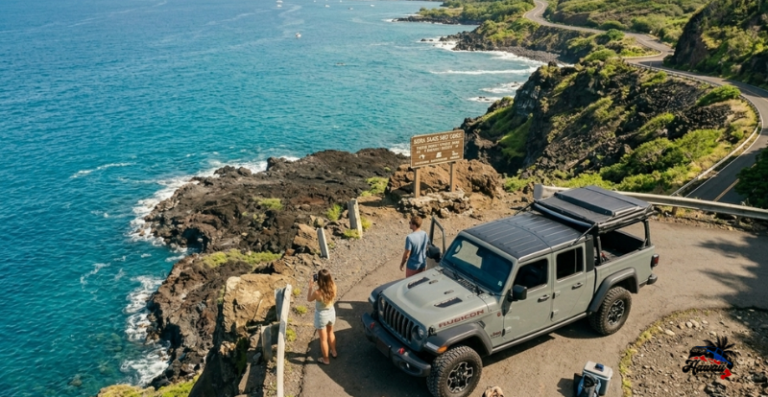
Every traveler landing at Kona International faces the same decision at the rental counter — and most of them get it wrong. They grab the cheapest compact available, hit the highway, and spend the week wondering why half the island’s best spots are behind signs that say “4WD required.” The right car rental Kona decision isn’t made at the counter. It’s made before you land. This guide lays out exactly what a lifted Jeep gets you that a regular rental car never will — and why it matters more than almost anything else you’ll plan for this trip.
Two Versions of the Big Island Exist — Your Vehicle Decides Which One You Get
Did you know?
“The Big Island spans over 4,000 square miles and contains eleven of the world’s thirteen climate zones. It has alpine tundra at 13,796 feet, black lava deserts at sea level, rainforests receiving 200 inches of rain a year, and coastal sand tracks that connect some of the most remote beaches on Earth”.
A standard rental car accesses one version of that island, the paved one. A proper Hawaii road trip vehicle built for actual terrain accesses both. Every major chain rental at Kona Airport generally includes explicit language banning their vehicles from:
- Mauna Kea summit access road above the visitor center
- Waipio Valley descent (25% grade, 4WD-Low required)
- Saddle Road high-elevation routes beyond certain markers
- South Point coastal 4WD tracks leading to Papakolea Green Sand Beach
- Polihale State Park on Kauai
Drive those routes in a standard rental, and you’re uninsured, unsupported, and in breach of your agreement. A lifted Jeep rental on the Big Island of Hawaii lifts every single one of them.
What Volcanic Road Conditions in Hawaii Actually Look Like
Most travelers don’t appreciate what volcanic road conditions Hawaii actually throws at a vehicle until they’re on the road. Sounds alarming. Here’s what you’re actually dealing with:
- Lava field roads — pāhoehoe and ʻaʻā lava surfaces create sharp, irregular textures that shred low-profile tires. Chain of Craters Road is paved, but the shoulders, pullouts, and unmarked tracks branching off it are raw lava rock.
- High-elevation grade changes — Saddle Road climbs from sea level to nearly 7,000 feet in under 40 miles. The temperature drops, the road surface changes character, and in the wet season, low-clearance vehicles lose traction on rain-slicked volcanic grades.
- Summit conditions on Mauna Kea — above the 9,200-foot visitor center, the access road turns to loose gravel and volcanic cinder. Ice is possible year-round. 4WD-Low isn’t a recommendation up here — it’s a requirement enforced at the checkpoint.
- Valley descents — Waipio Valley’s access road averages a 25% grade with blind switchbacks and stream crossings at the bottom. High-clearance 4WD with low-range gearing is the only safe configuration for the descent.
- Coastal tracks — South Point’s 4WD trail to Papakolea Green Sand Beach is unmaintained, with volcanic rock and packed sand. A standard SUV with no clearance gets beached. A lifted Jeep navigates it without drama.
A regular rental car isn’t built for any of this. It’s built for airport runs and resort shuttles.
What sets Hawaii Lifted Jeep Rental apart?
The phrase Jeep rental Big Island gets thrown around loosely. Not every Jeep rental is a lifted Jeep rental — and that distinction matters enormously on Big Island terrain.
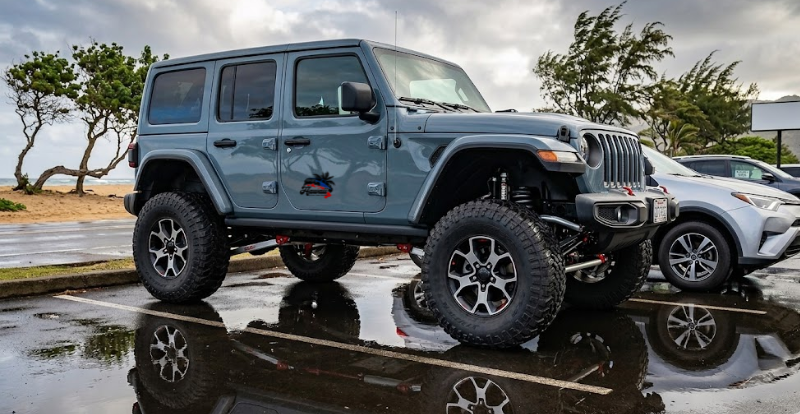
- Hawaii Lifted Jeep Rentals runs purpose-built vehicles:
- 1.5-inch lifts for genuine ground clearance over volcanic rock surfaces
- 33–35 inch tires for traction on loose cinder, packed sand, and wet lava grades
- True 4WD-Low gearing — not AWD, not traction control. Actual low-range 4WD for summit roads and valley descents
- Rubicon-grade axles on top-tier models for articulation on uneven terrain
- Mauna Kea-approved certification — the only rental fleet on the island cleared for the summit access road
Every vehicle in Hawaii Lifted’s fleet is inspected between guests, fueled before delivery, and delivered curbside at KOA.
- Hawaii adventure travel gear
Renting through Hawaii Lifted means your Hawaii adventure travel gear is handled:
- Beach gear included — chairs, umbrellas, reef-safe sunscreen; no tracking down a gear shop on day one
- Wireless Apple CarPlay and Android Auto on every vehicle for offline maps and navigation on Saddle Road, where cell service drops
- Tonneau-covered truck bed on the Gladiator Rubicon for gear storage on multi-day Big Island terrain driving routes
- Sky One-Touch convertible roof on select Rubicon models for open-air summit drives and coastal runs
- 24/7 local support — a real Kona team on call if anything goes sideways in terrain where a chain rental’s 1-800 number is useless
- Listed practical points and
- Base: Kona only — concierge delivery at Kona International Airport (KOA), $129 round-trip, and exclusively KOA-based operation
- Transparent pricing, zero hidden fees at pickup
- Unlimited island miles — drive the full Big Island loop without watching the odometer
- Fleet: Wrangler Willys Hard Top, Wrangler 4XE Hybrid, Rubicon Xtreme Recon, Gladiator Rubicon Soft Top
- Kauai coverage: Same team, Jeep rental Kauai fleet staged near Lihue Airport
- Hold policy: Reserve your vehicle for 24 hours with no card on file
The Bottom line
The Big Island does not reward the traveler who plays it safe at the rental counter. Volcanic road conditions are genuinely demanding. Big Island terrain driving requires mechanical capability that a standard airport rental simply doesn’t have. And Hawaii adventure travel gear shouldn’t be an afterthought, you scramble for on day two. The right car rental Kona decision — a lifted, Mauna Kea-approved Jeep from a family-run local operator with no damage deposit, no hidden fees, and curbside delivery at KOA — is the one that gets you everywhere this island has to offer.
Frequently Asked Questions
Q: How bad are volcanic road conditions in Hawaii for a regular car?
A: Volcanic road conditions in Hawaii range from manageable paved routes to raw lava rock tracks, loose cinder summit roads, and steep graded descents with stream crossings. A standard rental car handles the paved version fine. The moment you leave pavement — or attempt Mauna Kea above the visitor center — a standard vehicle is either out of its depth mechanically or banned by your rental agreement.
Q: Is there a damage deposit with Hawaii Lifted Jeep Rentals?
A: No. Hawaii Lifted charges no damage deposit. The quoted rate is the final rate — taxes and unlimited island miles included, no surprises at pickup.
Q: What Hawaii adventure travel gear is included with the rental?
A: Hawaii Lifted vehicles come with beach chairs, umbrellas, and reef-safe sunscreen. Select models include Sky One-Touch convertible roofs, Tonneau-covered truck beds for gear storage, and wireless CarPlay for offline navigation on remote routes.
Q: Does Hawaii Lifted operate out of Hilo?
A: No. Hawaii Lifted Jeep Rentals operates exclusively out of Kona, with concierge curbside delivery at Kona International Airport (KOA) for $129 round-trip. There is no Hilo location.
Q: Can I use Hawaii Lifted for a Jeep rental in Kauai, too?
A: Yes. The same family-run team operates a lifted fleet near Lihue Airport, covering Waimea Canyon, Polihale State Park, and the Hanalei north shore — same no-hidden-fees policy, same local support.
Ready for your island drive?
Reserve a lifted Jeep with a real Hawaii team behind it. No hidden fees, airport pickup included.