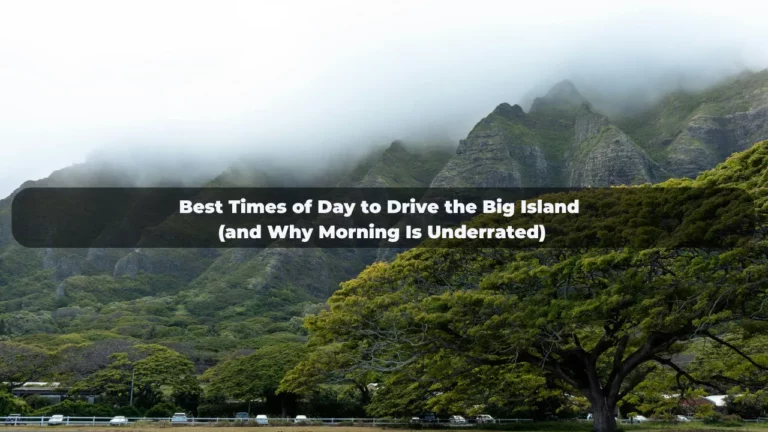
Sure, Hawaiʻi sunsets are legendary, but if you’re planning a full day of exploring by Jeep or SUV, you might want to reconsider what time you hit the road. The Big Island is enormous — 4,028 square miles — and the time of day affects everything from traffic and parking to weather, visibility, and how much of the island you actually see.
Here’s a practical breakdown of the best windows to drive, organized by what you’re trying to accomplish.
Early Morning (6 AM to 9 AM): The Underrated Window
Early starts are almost always better on the Big Island. Here’s why:
- Traffic in Kona and Hilo is minimal before 8 AM.
- Temperatures are cooler — this matters more than you’d expect if you’re planning open-air Jeep driving.
- Parking at beaches, lookouts, and trailheads is wide open. By 10 AM, most popular spots fill quickly.
- Morning light is softer and more flattering for photography, especially at the Waipiʻo Valley overlook and along the Hāmākua Coast.
- Weather tends to be clearer in the morning on the leeward (Kona) side before afternoon clouds build.
If you’re planning Mauna Kea, the summit road is best driven in the morning when conditions are driest and crowds at the visitor center are lightest.
Midday (10 AM to 2 PM): The Bright and Busy Stretch
Midday is when roads and parking lots hit peak capacity. For high-traffic destinations like Volcanoes National Park, Hapuna Beach, and the Kona waterfront, plan to be leaving these areas before noon if possible. That said, midday isn’t wasted time — it’s ideal for slower scenic segments, lunch stops in Waimea or Hilo, and any driving that doesn’t require a parking spot.
Late Afternoon (3 PM to 5:30 PM): Golden Hour Glow
Late afternoon light on the Big Island is spectacular, particularly along the Kohala Coast and on Saddle Road between the two volcanoes. The light gets warm and directional around 4 PM, making it one of the best times for driving purely for the view. Keep in mind that traffic picks up in the resort corridors between 3 PM and 5 PM as day-trippers head back to Kona.
Evening and Night (6 PM and later): Beautiful but Risky
Night driving on the Big Island deserves respect. Here’s what to know:
- Stick to main highways. Saddle Road, Queen Ka’ahumanu Highway, and Highway 11 are well-marked. Secondary roads — especially unpaved ones — are not.
- Watch for wildlife. Hawaiian hawks (ʻio), nēnē geese, and feral pigs cross roads at night, particularly in Volcano and on Saddle Road.
- Lava fields absorb road heat and can look deceptively flat — stay on marked roads.
- Plan your route before cell signal disappears. Many interior routes go dark on both signal and lighting.
Night driving at Volcanoes National Park is spectacular — the glow from active vents is a once-in-a-lifetime sight. Just go slow and stay on Chain of Craters Road.
Timing Tips Based on Activity
- Mauna Kea summit: Leave Kona by 10 AM at the latest. Arrive at the Visitor Information Station by 1 PM, summit by 3 PM, and descend before dark.
- Volcanoes National Park: Early morning for Thurston Lava Tube (before crowds), evening for lava glow viewing.
- Green Sand Beach (Papakōlea): Early morning — the hike and road are hot and crowded by 10 AM.
- Waipiʻo Valley overlook: Dawn for the quietest experience. Midday is fine if you don’t mind company.
- Kohala Coast beaches: Arrive by 8 AM if you want parking at Hapuna or Mauna Kea Beach.
Final Thoughts on the Best Times to Drive the Island
The simplest rule: start earlier than you think you need to. The Big Island rewards the early riser — better parking, better light, cooler temperatures, and a version of Hawaiʻi that feels quieter and more yours. Set the alarm an hour ahead of your normal vacation wake-up time and you’ll thank yourself by noon.
The Golden Hour Logic for Specific Routes
Sunrise is best for Mauna Kea: you drive up in the dark (4am departure from Kona), watch the sunrise above the clouds at 13,800 feet, then descend as the summit road fills with tourists. By 9am you are back at the Visitor Information Station and the rest of the day is yours. Our Rubicon Extreme Recon handles the cold summit road in full darkness with confidence ? the factory 35-inch BFG tires and 4WD-Low make the summit switchbacks feel controlled rather than dramatic.
Midday belongs to the south: Green Sand Beach at South Point (Ka Lae), Milolii, or Chain of Craters Road in Volcanoes National Park. These routes face west or south and the light is flat enough for photography while being bright enough to see the lava detail. The road to Green Sand is unmaintained for 2.5 miles from the parking area ? real 4WD required, no rental company permits it except us.
Sunset is Kohala Coast: Hapuna Beach, Mauna Kea Beach Hotel grounds, Spencer Beach Park. The sun drops behind Hualalai to the west and turns the lava fields orange. Drive it open-air if the trade winds are up ? which they usually are.
Times to Avoid
- 8:30am?10am on H-19 (the Belt Road north of Hilo): school and work traffic makes the four-lane section slow without reward
- Friday 3?6pm on Queen Kaahumanu Highway: the Kona commute is real and makes the Waikoloa exits back up
- Mauna Kea summit road after 2pm: afternoon clouds roll in from the east and can close the summit road entirely
See our full fleet page to match the time of day and route to the right vehicle, or reserve your dates now.
Ready for your island drive?
Reserve a lifted Jeep with a real Hawaii team behind it. No hidden fees, airport pickup included.