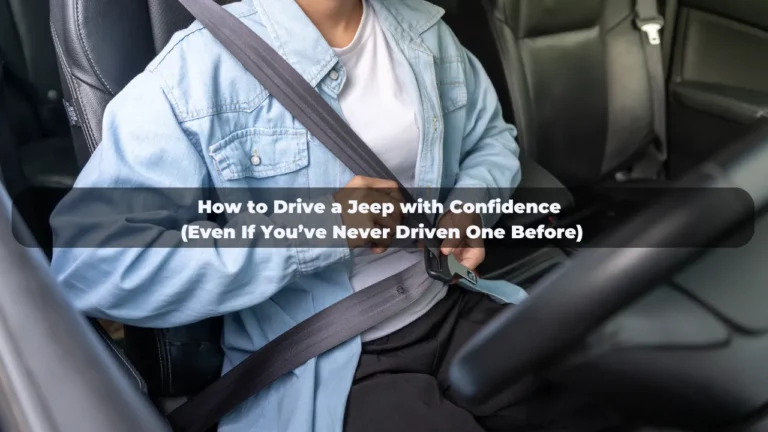
Renting a Jeep in Hawaiʻi sounds awesome — until you’re on a steep gravel road wondering what 4H or 4L even means. If you’ve never driven a Jeep or SUV before, it can feel a little intimidating at first. The good news is that modern Jeeps are genuinely easy to drive in most conditions, and a five-minute orientation before you leave the parking lot removes nearly all of the uncertainty.
Here’s what you need to know.
Get Familiar Before You Drive
Before you pull onto the road, spend five minutes in the parking lot getting oriented. This isn’t just good advice — it’s the difference between a confident first hour and a stressful one.
- Find the 4WD selector. On most Wranglers it’s a lever or dial between the seats labeled 2H, 4H, 4L, and sometimes N (neutral for towing). On the Grand Wagoneer and Ford Bronco, it’s typically a dial or button on the center console.
- Locate the hazard lights, defrost controls, and the spare tire latch (important to know before you need it).
- Adjust mirrors and seat position before you move. The Wrangler sits taller than a sedan — your sight lines are different.
- Walk around the vehicle once before departure. Know what it looks like clean so you can spot anything that happens on the road.
Understanding 4WD (Without Freaking Out)
Four-wheel drive is simpler than it sounds. Here’s what each setting actually means for everyday driving:
- 2H (2-wheel drive, high range): Normal driving mode for paved roads. Fuel-efficient, standard handling. Use this on the highway, in town, and anywhere dry and paved.
- 4H (4-wheel drive, high range): Engage on loose gravel, wet roads, dirt tracks, and rough unpaved surfaces where you still need to move at normal speeds. Perfectly fine to drive up to highway speeds in 4H for short stretches. This is your everyday off-pavement mode.
- 4L (4-wheel drive, low range): For steep, slow, technical terrain — deep sand, loose lava rock, very steep descents. On most vehicles, you need to stop or move very slowly to shift into 4L. The Mauna Kea summit road above the Visitor Information Station is the main place you’ll use 4L on the Big Island.
On Wranglers, shift between 2H and 4H at any speed. To engage 4L, slow to under 3 mph, shift to neutral, and then move the lever to 4L. We’ll show you the specific procedure for your vehicle at hand-over.
Driving Tips for New Jeep Drivers
The Wrangler drives differently from a sedan or crossover. Here’s what to expect:
- It’s taller. You’ll feel wind more at highway speeds. This is normal. On the Big Island, highway speeds of 45–55 mph are typical, and a Wrangler is stable at those speeds.
- The steering is more direct. Don’t overcompensate. Gentle inputs on paved roads, slightly firmer ones on rough terrain.
- Go slow on rough surfaces. The Jeep can handle more than you can feel from the seat. Slow and smooth is always faster than fast and bouncy.
- Use engine braking on descents. On steep downhill sections, drop to a lower gear instead of riding the brakes. This is especially important on the Mauna Kea summit road.
- Watch your width in tight spots. The Wrangler is wider than it looks when you’re parked. The side mirrors add several inches beyond the body. Take tight turns wide.
Helpful Features That Come With Most Jeeps
- Hill Descent Control: On Rubicons and Extreme Recons, this holds your speed on steep descents automatically. Use it on the Mauna Kea summit road — it’s what it’s designed for.
- Locking Differentials: On Rubicon-trim vehicles, the front and rear axles can be locked for maximum traction on loose surfaces. We’ll show you how to use them if your vehicle has them.
- Removable Doors: Wrangler doors come off. If you want to drive open-air, we can remove them at hand-over. Just tell us. They store in the cargo area or at our shop.
- Soft Top vs. Hard Top: Most of our Wranglers have soft tops. They’re easy to fold back or remove for open-air driving. We’ll show you the operation at hand-over.
If you have questions during your rental — on a road you’re not sure about, a warning light you don’t recognize, or a 4WD mode you want to double-check — call us at (808) 657-4807. We’re local, we know the roads, and we answer.
Mauna Kea Summit Road: What to Expect in 4WD-Low
The summit road above the Visitor Information Station is the most technically demanding drive in our fleet’s approved range. It is 5 miles of unpaved switchbacks rising from 9,200 feet to 13,800 feet. In 4WD-Low with the transfer case engaged, the engine braking keeps your speed in check on the descent without touching the brake pedal. Here is the sequence: stop at the VIS, shift to 4WD-Low (neutral through high into low, not while rolling), proceed to the summit at under 15mph, take photos, then descend in 4WD-Low all the way back to the VIS before shifting back to 4-High. Do not attempt in regular 4-High ? brake fade on the descent is a real risk.
Removing Doors and the Soft Top
This is the most common “can I do that?” question we get, and the answer is yes ? with a quick demo from us at hand-off. The T-handle bolt on each door takes 30 seconds; the door weighs about 35 lbs and stores flat in the back. The soft top folds behind the rear seats in one motion. Driving doorless on the Kohala Coast or the north-shore loop on Kauai is one of the genuinely transcendent travel experiences in the islands. We specifically built our fleet around the Wrangler for this reason.
Off-Road Confidence Ladder
Not all off-road is the same. Here is a simplified confidence ladder:
- Level 1 (any Jeep): unpaved parking areas, dirt roads with firm base ? Kohala ranch roads, Waimea Canyon in Kauai
- Level 2 (4WD-High): washboard gravel, mild ruts, loose rock ? Polihale access road, South Point approach to Ka Lae
- Level 3 (4WD-Low): steep grades, loose surface, rock steps ? Green Sand Beach track, Mauna Kea summit road above VIS
- Level 4 (Low + lockers): significant boulder fields, steep V-shaped ruts ? only our Rubicon Extreme Recon with activated lockers is appropriate here
Know your level before you leave the pavement. We tell every renter at hand-off exactly which level their route requires and which level their vehicle handles. Book the right Jeep for your route.
Ready for your island drive?
Reserve a lifted Jeep with a real Hawaii team behind it. No hidden fees, airport pickup included.