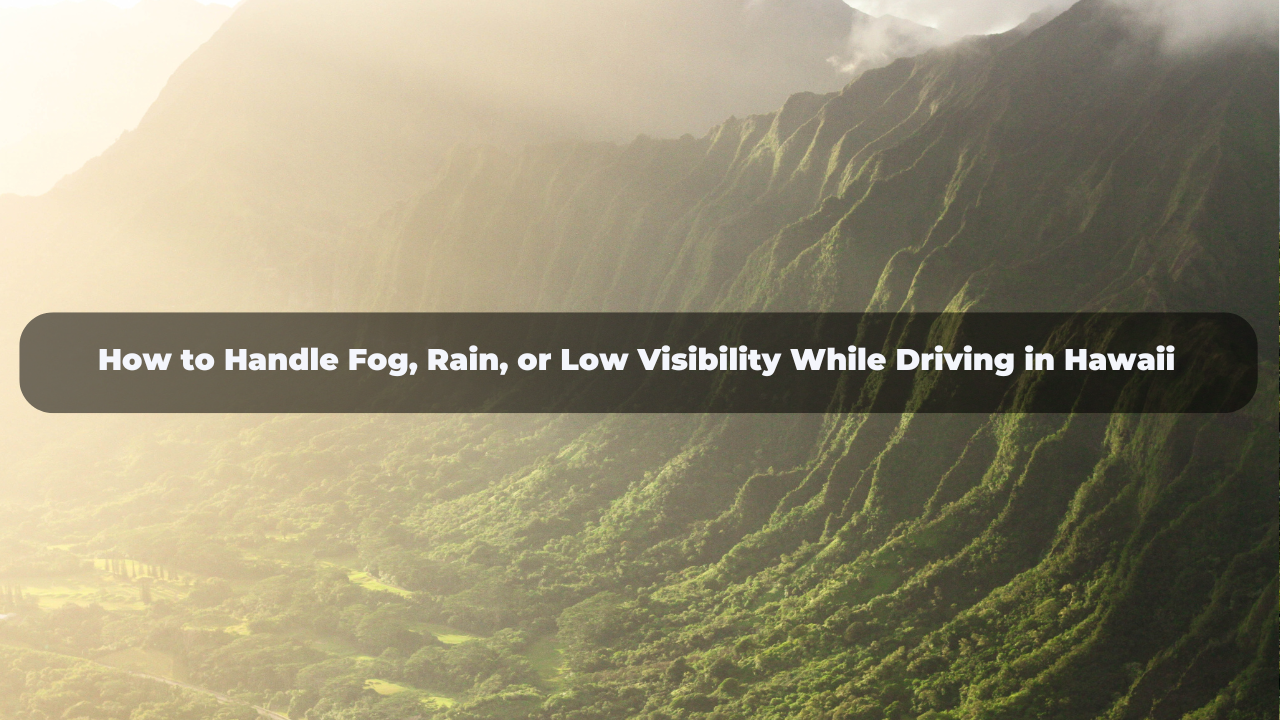
The Big Island’s beauty comes with some unpredictable weather. Between its high elevations, rainforests, and open coastlines, it’s common to hit sudden patches of fog, rain, or even both at once. Knowing how to handle these conditions — and when to simply pull over — can make the difference between a nerve-racking drive and a manageable one.
Tips for Driving in Fog
Fog on the Big Island tends to roll in fast, especially on Saddle Road, Waimea, and the Mauna Kea Access Road. When visibility drops:
- Switch to low-beam headlights. High beams reflect off the fog and make visibility worse.
- Slow down and increase your following distance significantly.
- Use painted road lines and reflectors as your guide — stay in your lane and don’t straddle the center line.
- If you must stop, pull completely off the road. Never stop in an active travel lane.
- Turn on your hazard lights if you’re pulled over and visibility is dangerously low.
Tips for Driving in Rain
Rain on the Big Island can go from light drizzle to full downpour in minutes, especially in Hilo and along the Hāmākua Coast. Here’s how to drive safely:
- Turn on your headlights as soon as rain starts — not just for your visibility, but so others can see you.
- Watch for standing water and puddles, especially on lower roads near the coast.
- Brake gently and gradually. Sudden hard stops on wet roads increase the risk of skidding.
- Use your defogger early to prevent windshield fog from the inside.
- Avoid using cruise control in wet conditions — you need full manual control of your speed.
General Tips for Low Visibility Driving
Whether it’s fog, rain, or a combination of both, a few general habits apply in all low-visibility situations:
- Reduce speed to match conditions, not just the speed limit.
- Keep a safe distance from vehicles ahead — double what you’d normally allow.
- Avoid distractions. Put the phone away and focus on the road.
- Know your route. Low visibility is more manageable when you know what turns and intersections are ahead.
What to Pack in Your Jeep or SUV
A few simple items in your rental can make a big difference if conditions turn:
- A physical map or downloaded offline map — phone signal drops in many Big Island zones.
- Layers. Temperatures drop fast at elevation even in summer.
- A flashlight or headlamp for emergencies.
- Water and snacks in case you’re waiting out a weather window.
What to Do If You Feel Unsafe Driving
If conditions become genuinely unsafe, the right move is simple: pull over in a legal, clearly visible spot, turn on your hazard lights, and wait it out. Most Big Island weather passes within 20 to 30 minutes. It’s always better to arrive late than to push through visibility that feels wrong.
If you’re renting with us, call us. Our number is (808) 657-4807. We know the island’s weather patterns and can advise on the best approach for your specific route.
Final Thoughts on Handling Fog, Rain, and Low Visibility
The Big Island’s climate variety is part of what makes it extraordinary — you can drive from lava fields to cloud forest in under two hours. That variety comes with weather that changes fast. Slow down, stay lit, and give yourself room to react. The views on the other side of the cloud are worth it.
Which Vehicle Handles Hawaii Weather Best?
The height of a lifted Jeep matters more in fog and rain than the drivetrain. Sitting 4-6 inches higher than a sedan means you see further through ground-level fog and the road surface pooling is less alarming from the driver’s seat. Our Wrangler Rubicon is the most popular choice for Saddle Road weather conditions because its removable-door design lets you hear rain before it hits ? a useful early warning. For families wanting a closed cabin during a Hilo-side squall, the Grand Wagoneer is the right call: all-wheel drive, full-length panoramic roof, and a sealed interior that keeps everyone dry.
Route Adjustments for Rainy Days
Rain should redirect your route, not cancel it. On the Big Island, the east side (Hilo, Hamakua Coast, Waipio Overlook) is wet by design ? the lush green scenery you came for exists because it rains 150 inches a year. Drive it wet with confidence. The west side (Kona, Kohala Coast, Mauna Kea summit road) is dramatically drier, so if Saddle Road is socked in, pivot to the Kohala Mountain Road or the Kawaihae-to-Hawi run along the coast. On Kauai, north-shore rain is persistent in winter; the south shore near Poipu gets significantly less. If Hanalei is under a cloud bank, drive to Waimea Canyon instead ? it is almost always clearer on the west side.
Emergency Checklist Before Driving Into Fog
- Check the DLNR Mauna Kea weather cams before heading above the Visitor Information Station
- Switch to low beams ? high beams reflect back and reduce visibility further in fog
- Turn on hazard lights if you must pull over on Saddle Road
- Keep the soft top on or use the hard top if conditions deteriorate ? exposed rain driving is uncomfortable and the door seals leak when doors are removed
- Text us from a real Hawaii number if you hit a closed road ? we give real-time local advice
Ready to plan your route? Check availability for your dates and we will brief you on current road conditions at hand-off.
Ready for your island drive?
Reserve a lifted Jeep with a real Hawaii team behind it. No hidden fees, airport pickup included.